Corporate License
$299
- For single organization
- License validity and updates - 1 Year
- Recover corrupt MDF and NDF files
- Restore all database objects
- Supports SQL server from 2000 to 2025
Scan corrupt or inaccessible MDF and NDF files and restore all objects to a live SQL database or SQL scripts. Recover SQL database without transactional log files or modifying the original database.
Check out the different scenarios where the MS SQL Database Recovery tool comes in handy.
Sometimes, your SQL Server database might become corrupted due to system crashes, hardware issues, or storage failures, making database inaccessible. With our SQL recovery tool, you can bypass the corruption and recover the database.
Database administrators struggle to repair SQL database when the log files are missing or corrupted. In such scenarios, our SQL recovery software allows scanning the MDF or NDF files and recovering data without the need for the transaction log files.
When you have accidentally deleted some crucial tables from the SQL database and you don’t have a backup to restore them, our SQL Server database recovery tool can help. Recover lost or deleted records with original values and keys without a backup.
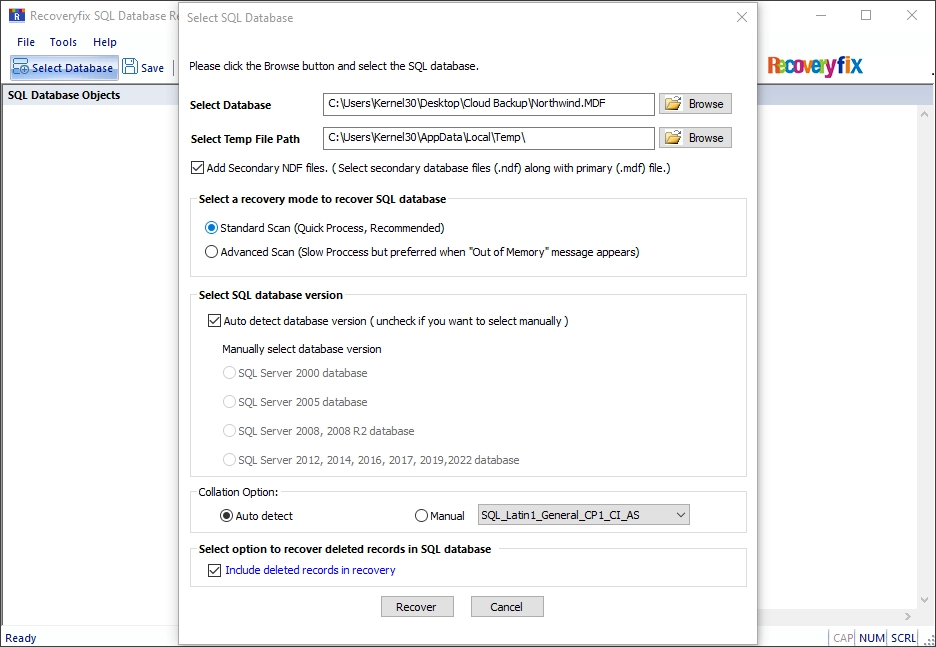
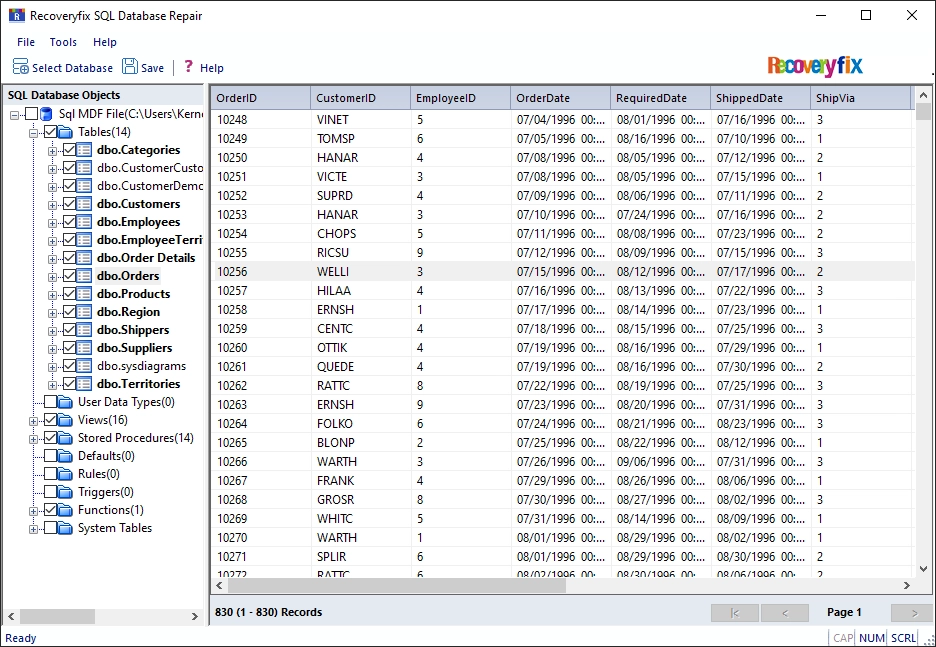
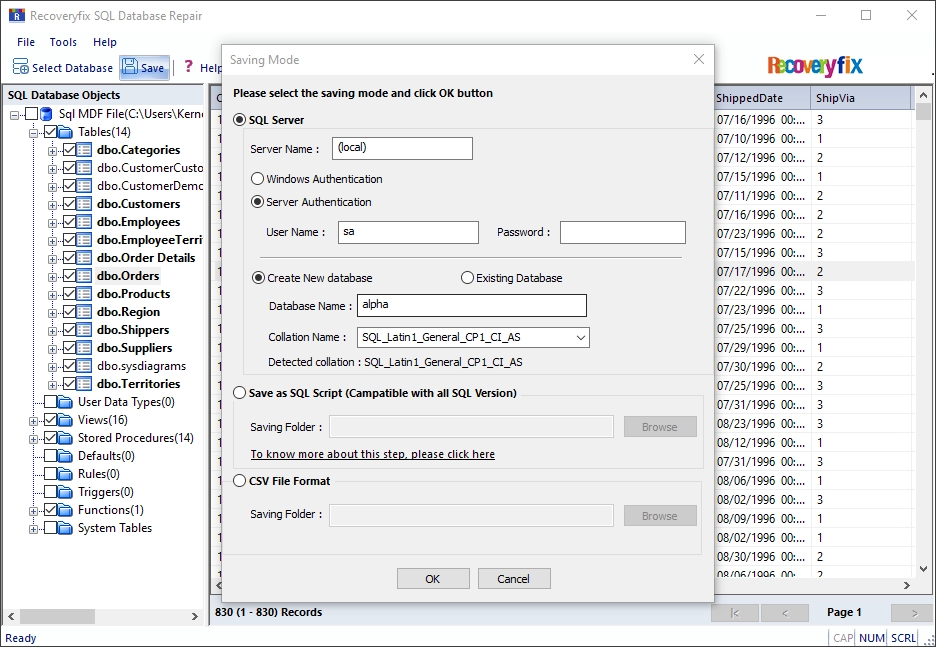
Here are the detailed steps to Recover SQL database in four simple steps:
Explore the powerful capabilities designed to recover database objects, restore records, and simplify SQL database recovery.

Recover inaccessible data caused by consistency issues or corruption in a SQL database. Our SQL database recovery software allows quick scanning and recovery of the database to your preferred destination.

Restore all SQL database objects, including tables, views, indexes, rules, stored procedures, triggers, data types, system tables, functions, while maintaining the data integrity of table records and SQL queries.

The Recoveryfix for SQL database recovery tool offers two scanning modes. Use the Standard Scan to quickly recover minor corrupted database files and the Advanced Scan to recover severely corrupted files.

After scanning, the SQL Server recovery tool displays all the recoverable database objects. You can select and preview any database item, including tables, functions, etc., before saving them.

The Microsoft SQL Server recovery tool automatically detects the SQL Server version of the database, which helps in maintaining the correct database internal structure during recovery. Additionally, you can manually choose the version if required.

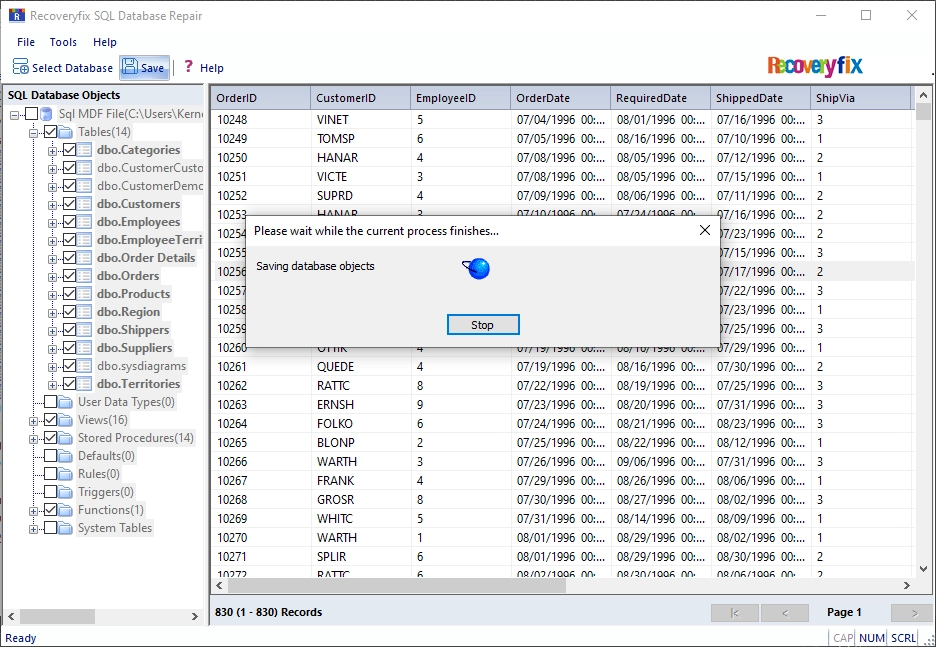
Save the recovered database directly to a live SQL Server with MS SQL Recovery tool. Choose an existing database or create a new database directly from tool to save the recovered data.

The SQL database recovery tool allows saving the database objects into SQL Scripts that you can use to insert data to any database whenever required. This option is helpful when a live SQL database is unavailable.

Save database tables as CSV files and access them using any spreadsheet tool like Excel on any device, including mobile. The tool saves each table in a separate CSV file, meaning 10 tables will be saved as 10 CSV files.

The SQL Server recovery software Auto detects the collation type of the added SQL Server database, or you can select it manually. This helps in preserving the special characters and language of the database.

Easily restore the accidentally deleted or lost records from the database file. In addition to recovering the corrupt data, the SQL recovery database software also allows recovery of deleted tables from the database.

Recover data from both primary (MDF) and secondary (NDF) SQL Server data files. You can add MDF and NDF files together and recover multiple SQL database files in one go.

Select and save specific database objects when complete database recovery is not required or the destination server does not have enough free space. Additionally, the tool allows saving different database objects to separate live databases.
Microsoft SQL Server uses three types of database files:
MDF (Master Data File)): It is the primary file in a database that is mandatory for booting up the database and stores database objects like tables, views, stored procedures, and many more.
NDF (Next Data File): Also called a secondary database file. Stores similar data as the MDF and is used to extend or scale up storage requirements when the MDF file reaches its size limit.
LDF (Transaction Log File): Records all database transactions and changes. The file is crucial for maintaining data integrity and supports rollback operations.


Corruption in SQL Database files can occur due to several factors, often without warning. These common causes include:
Hardware Malfunction affecting read/write operations.
Disk-related issues like bad sectors or storage media failure.
Malware or virus infections targeting system and database files.
Interrupted or incomplete upgrades of SQL Server or database files.
Sudden power failures or abrupt shutdowns during database transactions.
When corruption occurs, users may encounter these typical SQL Server error messages:
"The file is not a primary database file."
"Page-level corruption detected in the database,"
"SQL Server detected a logical consistency-based I/O error."
"Could not continue scan with NOLOCK due to data movement."
"The header for file 'XYZ.mdf' is not a valid database file header."

The software helps ensure that no essential data is left behind. From critical tables to complex triggers, it restores the objects users need for a fully functional database.
 Tables
Recover all user-defined and system tables along with their complete data and structure.
 Views
Restore both simple and complex SQL views with complete dependencies.
 Stored Procedures
Fetch and restore your stored procedures exactly as they were before corruption.
 Triggers
Bring back all your automated trigger logic without any data loss.
 Functions
Supports the recovery of user-defined functions to keep your business data functioning intact.
 Rules
Restore rules applied on columns to maintain data integrity.
 Defaults
Recover default values set for specific columns or tables.
 Indexes
Retrieve all clustered and non-clustered indexes for optimized database performance.
 Keys
Recover primary keys, foreign keys, and unique constraints to preserve relational accuracy.
 User-defined Data Types
Restore custom data types used in table definitions or procedures.
 Collations
Maintain database collation settings during recovery to avoid compatibility issues.
| Software Features | Trial Version | Full Version |
| Deep scan of corrupt MDF and NDF files | ✔ | ✔ |
| Recover all SQL database components | ✔ | ✔ |
| Preview all recovered items | ✔ | ✔ |
| Data recovery from large SQL databases | ✔ | ✔ |
| Select database version | ✔ | ✔ |
| Auto-detects SQL database collation type | ✔ | ✔ |
| Save the recovered data | ✕ | ✔ |
| Save database into to SQL Script or CSV file | ✕ | ✔ |
Download Demo  |
Upgrade Now  |
Recoveryfix SQL Recovery offer two license option. Choose the right licence as per your business requirements.
Find answers to common questions about SQL database recovery, supported file types, scanning modes, and the recovery process.
I did not have the log files and was afraid that I might lose my data forever. But thanks to Recoveryfix SQL Recovery, I was able to get it all back. The tool fixed the broken database structure and recovered all the objects without needing the logs.
4Highly impressed with Recoveryfix SQL Database Recovery! It handled my corrupted SQL database files effortlessly, and the user-friendly interface made the whole process straightforward. Thank you for such an incredible tool!
5